
The OBD2 GPS Tracker Debate: Power vs. Communication and Why It Matters

Introduction: The Confusion and Fears
GPS companies seldom use OBDII GPS systems because their overt nature does not support vehicle security. Often, these companies publish inaccurate information suggesting that all OBDII GPS trackers will increase risk to the vehicle owner.
The common fear is understandable: "If I plug something into my car's diagnostic port, am I giving hackers access to my vehicle? Will it void my warranty? Can someone track me without my knowledge?"
These aren't paranoid questions; they're legitimate concerns that deserve straight answers. The problem is that most marketing materials treat all OBD2 trackers as identical, when in reality, they are fundamentally different devices that interact with your vehicle in entirely different ways.
The OBD2 port was designed in the 1990s as a standardized diagnostic interface for emissions testing and repair shops. It was never intended to be a consumer data portal or a security device, and this legacy creates the confusion we see today.
The Trinidad and Tobago Context: Why This Matters Now
Vehicle theft in Trinidad and Tobago has reached crisis levels. Between 2021 and 2023, motor vehicle theft spiked by over 300 percent, with as many as 1,800 vehicles stolen annually. The Trinidad and Tobago Police Service's retrieval rate remains around 35 percent, and much of that recovery is due to private GPS tracking systems.
The Nissan Tiida is the most stolen vehicle in Trinidad and Tobago, with the North-Central Division, from St Joseph to Arouca and including the Tunapuna district, reporting the highest number of cases. The Kia K2700 and Hyundai H100 vans are also popular targets, as they can be used to move stolen items.
As one security professional put it, "Car thieves are operating like professionals now. They move at 2 am, strip a vehicle in 30 minutes, and disappear. By morning, what was once a $400,000 SUV is just parts scattered across the country."
Yet despite this crisis, only 30 percent of vehicles on Trinidad and Tobago's roads are equipped with tracking devices—and many of those are inactive.
The Argument: It All Comes Down to the Pins
Here's the core of our argument: Not all OBD2 GPS trackers are created equal, and the difference lies in which pins of the connector they actually use.
The 16-pin OBD2 connector looks identical regardless of what's plugged into it, but what happens inside those pins determines everything about the device's safety, intrusiveness, and risk profile.
The Power-Only Pins (4 and 16)
Pin 4 (Chassis Ground) and Pin 16 (Battery Positive) serve one simple purpose: they deliver electricity. Pin 16 provides constant, unswitched 12V power directly from your vehicle's battery, while Pin 4 completes the circuit.
A GPS tracker that uses only pins 4 and 16 is functionally equivalent to plugging a phone charger into your cigarette lighter. It draws power, but it doesn't talk to your car's computers. It's a passive electrical load, nothing more.
No communication with the vehicle's computers
No ability to read or clear diagnostic trouble codes
No CAN bus access
No interference with vehicle systems
Minimal cybersecurity risk
The Communication Pins (2, 6, 7, 10, 14, 15)
The remaining pins are dedicated to various communication protocols that allow external devices to talk to your vehicle's internal networks. These pins transform a simple power plug into an active participant in your car's digital ecosystem.
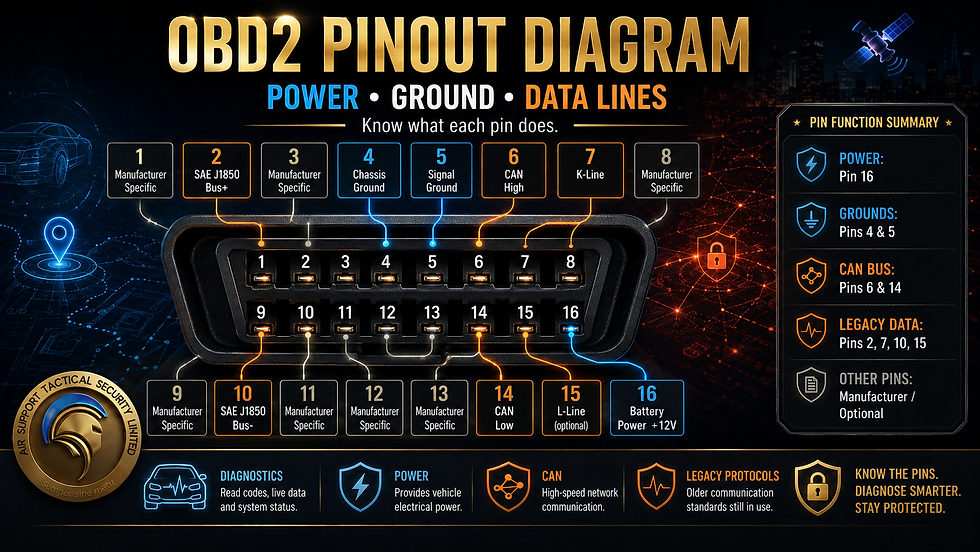
Pin(s) | Protocol | Vehicles |
2 & 10 | SAE J1850 | Ford, GM, older vehicles |
6 & 14 | CAN Bus (ISO 15765) | Most vehicles 2008+ |
7 & 15 | ISO 9141-2 / KWP2000 | European, Asian vehicles |
"The OBD2 port is a direct, unauthenticated gateway to the CAN bus. A tracker connected to the CAN pins is a potential entry point for attackers."
A tracker that uses these communication pins can:
Read engine RPM, speed, coolant temperature, and fault codes
Access the CAN bus, the vehicle's internal nervous system
Potentially interfere with vehicle functions
Introduce cybersecurity vulnerabilities
Raise warranty and liability concerns
Pros and Cons: Power-Only vs. Communication-Enabled
Power-Only GPS Tracker
✅ Pros
No cybersecurity risk: Cannot be used to hack or access vehicle systems
No interference: Doesn't disrupt CAN bus communication
Warranty safe: No modification or tapping into vehicle electronics
Privacy controlled: Only transmits GPS data, not vehicle diagnostics
Simple installation: Truly plug-and-play with no configuration
Reliable: Fewer failure points without CAN bus dependency
Constant power: Always charged, no battery maintenance
❌ Cons
No engine diagnostics: Cannot read check engine lights or performance data
Limited data: No speed, RPM, or fuel economy reporting
Easily removed: Still an external device that can be unplugged
Overt nature: Visible under the dashboard
Communication-Enabled GPS Tracker
✅ Pros
Rich vehicle data: Engine diagnostics, speed, fuel consumption, fault codes
Behavior monitoring: Detailed driving insights for fleets or teen drivers
Maintenance alerts: Early warning of mechanical issues
❌ Cons
Cybersecurity risk: Potential entry point for attackers
CAN bus interference: Faulty devices can disrupt vehicle communication
Warranty concerns: Connecting a device that writes to or reads from the vehicle's CAN bus is where the question of manufacturer warranties becomes complex. BMW's senior vice-president of electronics, Christoph Grote, explicitly stated: "OBD has been designed to service cars in repair shops. In no way has it been intended to allow third parties to build a form of data-driven economy on the access through this interface."
Data privacy: Diagnostic data may be collected and shared with third parties
Overt nature: Still a visible device that thieves can spot and remove
Parasitic drain: May prevent vehicle computers from entering sleep mode
Potential liability: Using CAN-reading devices while driving may impact liability claims
The Real Risk: Why the OBD2 Tracker Alone Isn't Enough
Regardless of which pins a tracker uses, all OBD2 devices share a fundamental weakness: they are overt and removable.
An OBD2 GPS tracker is usually visible under the dashboard. A thief who knows what they're looking for can simply unplug it and toss it out the window. Some devices offer tamper alerts, but this is little comfort when you're watching your car drive away.
Furthermore, sophisticated thieves are increasingly using GPS jammers that block GPS and cellular signals, rendering any single tracker ineffective. As one industry analysis notes, using a professional SVR system increases vehicle recovery odds dramatically compared to the 35 percent recovery rate for vehicles without such devices .
The Myth Debunked: Nothing to Fear, Just Choose Wisely
Now let's address the elephant in the room. There's a pervasive myth that all OBD2 GPS trackers are dangerous, invasive, or a cybersecurity nightmare. This simply isn't true.
The Myth: "OBD2 Trackers Will Hack My Car"
The Reality: A power-only tracker using pins 4 and 16 is electrically inert. It has no more ability to hack your car than a USB charger has to hack your phone. It draws power and nothing more. It's a passive device that listens to GPS satellites and transmits location data; it doesn't listen to your car's internal conversations.
"A device that uses only pins 4 and 16 is functionally equivalent to a power cord. It has no ability to read, write, or interfere with vehicle data."
The Myth: "OBD2 Trackers Void My Warranty"
The Reality: A device that draws power from the OBD2 port without communicating with vehicle computers is not considered a modification that would void a warranty. Only devices that write to the CAN bus or alter vehicle behavior could potentially raise warranty concerns, and even then, the manufacturer would need to prove the device caused the failure.
The Myth: "Thieves Can Use My OBD2 Tracker Against Me"
The Reality: A power-only tracker doesn't provide any information that a thief could use against you. It doesn't know your vehicle's VIN, store driving history, or communicate with your car's computers. It's simply a GPS transmitter. The only risk is that the thief might find it and remove it, which is a physical, not a cybersecurity, risk.
The Myth: "All OBD2 Trackers Are the Same"
The Reality: This is the most dangerous myth of all. Treating a power-only tracker and a CAN-connected tracker as interchangeable products is like treating a flashlight and a power drill as the same because they both plug into the wall. They serve different purposes, use different resources, and carry different risks.
The Myth: "My Location Data Will Be Abused"
The Reality: This fear is a legitimate concern, but it's manageable. Before purchasing a tracker, read the privacy policy. Does the manufacturer sell your location data? Does the dealership get access? Is there a third-party data broker involved? Choose a provider that respects your privacy and is transparent about its data-handling practices.
Making the Right Choice: A Buyer's Checklist
When choosing an OBD2 GPS tracker, ask these questions:
Does it read vehicle diagnostics? If so, does it connect to the CAN bus or other communication protocols? This method is the more intrusive option.
Does it only need power? If the device description focuses on GPS, GSM, and battery requirements without mentioning engine data, it's likely power-only.
What data does it share and with whom? Read the privacy policy. Does the manufacturer sell your location data? Does the dealership get access? Is there a third-party data broker involved?
What's the physical security? Is there a tamper alert? Can it be easily removed? Is there a way to secure the device to the port?
What's the power consumption? Will it drain your battery if the vehicle sits for extended periods?
The Bottom Line: Choose Wisely, Drive Confidently
The OBD2 GPS tracker is a tool. Like any tool, it's safe when used correctly and risky when misused. The fear and confusion surrounding these devices comes primarily from a lack of understanding about how they actually work.
Here's the simple truth:
If you want a simple tracking device with no cybersecurity risk, choose a power-only tracker that uses pins 4 and 16. It's safe, warranty-friendly, and effective.
If you want diagnostic data and vehicle monitoring, understand that you're connecting to the vehicle's CAN bus. Accept the associated risks, choose a reputable manufacturer, and be aware of privacy implications.
If you're buying based on price alone, remember that the cheapest device often comes from a manufacturer with questionable security practices. Read reviews, check for security audits, and understand what you're buying.
"There's no need to fear the OBD2 port. It's a standardized interface designed for legitimate diagnostic purposes. The only thing to fear is buying a device without understanding what it actually does."
The myths about OBD2 GPS trackers persist because people poorly understand the technology. But the reality is straightforward: these devices range from simple power adapters with GPS to full vehicle diagnostic systems. The risk level varies dramatically between these extremes.
The choice is yours. Armed with the knowledge of what actually happens inside those 16 pins, you can select a tracker that meets your needs without compromising your security, privacy, or peace of mind.
Final Thought: The OBD2 Port Is Not the Enemy
The OBD2 port is a tool, not a threat. It was designed to help diagnose and repair vehicles, and it continues to serve that purpose admirably. The fears surrounding OBD2 GPS trackers are largely based on misunderstanding and misinformation.
A power-only GPS tracker using pins 4 and 16 is no more dangerous than plugging in a phone charger. A CAN-connected diagnostic tracker is a different beast entirely, but even that is safe when chosen carefully and used responsibly.
The key takeaway: don't fear the port; fear ignorance. Understand what you're buying, choose devices that match your actual needs, and ignore the sensationalist headlines that paint all OBD2 devices with the same brush.
Your vehicle is a significant investment. Protecting it with a GPS tracker makes sense. Just make sure you're protecting it with the right kind of tracker, one that balances functionality with security, privacy, and peace of mind.


Comments